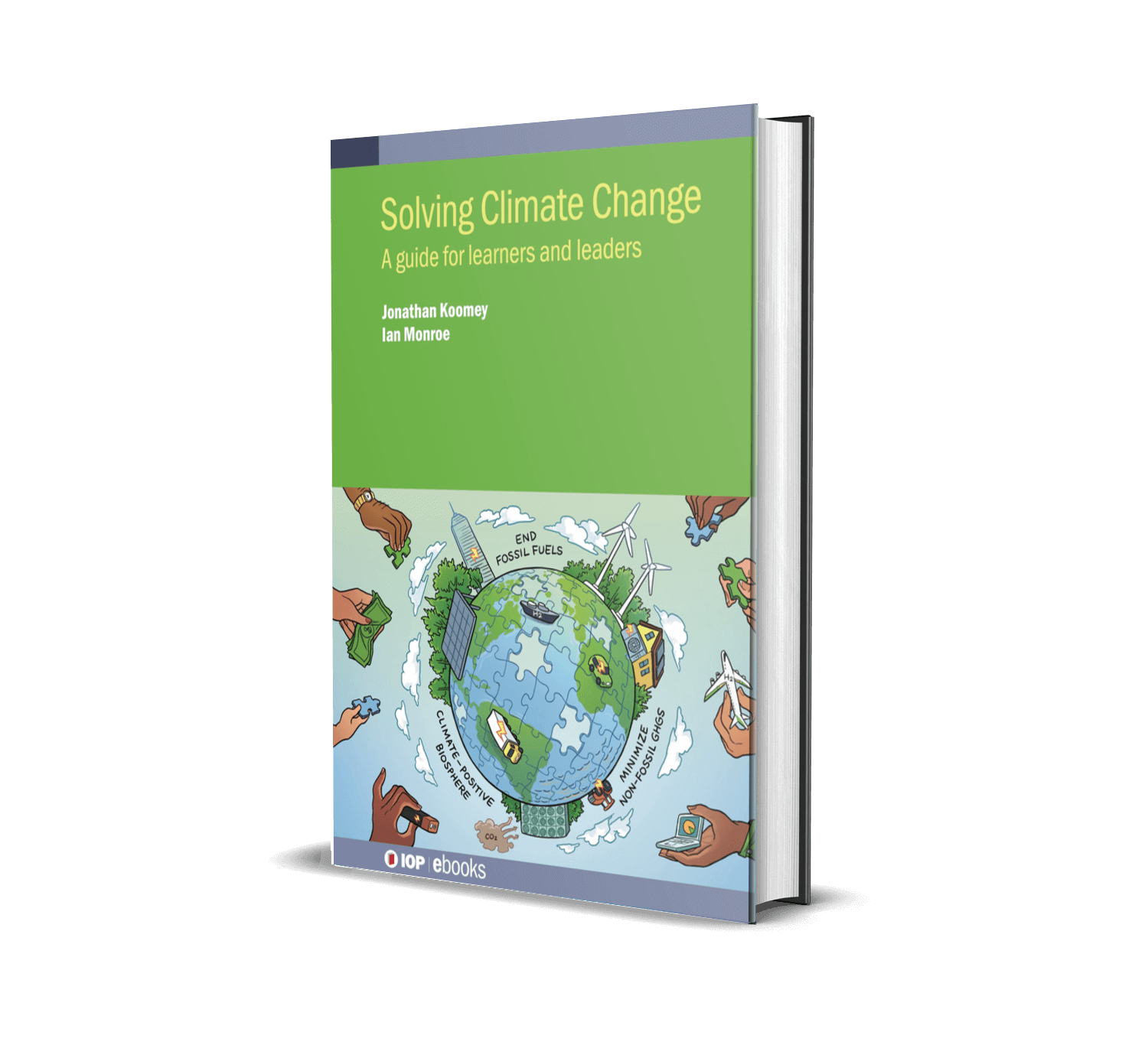
“There’s still a window of time to minimize the effects of climate change, but it’s going to take all of us working together to get it done. This book will serve as a great resource for anyone looking to be part of the solution.”
– U.S. Senator Sheldon Whitehouse
“If you’re looking for a go-to text that covers the science, impacts, economics and policy dimensions of the climate crisis, look no further than Solving Climate Change: A Guide for Learners and Leaders by Jonathan Koomey and Ian Monroe. This highly readable text doesn’t shy from the key science and policy details, making it the perfect choice for an introductory college course on the climate crisis.”
– Michael Mann, Presidential Distinguished Professor, University of Pennsylvania and author of The New Climate War
“Solving Climate Change is the best primer and action guide I know: magnificently terse, clear, accurate, and inspiring. Read it. Do it. Spread it.”
— Amory B. Lovins, Adjunct Professor of Civil and Environmental Engineering, Stanford University; Cofounder, RMI (Rocky Mountain Institute)
“This book is a tremendous resource for those trying to create a thriving and resilient energy economy centered on climate action, equity, and justice.”
– Professor Dustin Mulvaney, Environmental Studies, San José State University and author of Sustainable Energy Transitions
“Finally a Climate Change textbook that provides a comprehensive, solution-based guide to how we can make the changes need to achieve the near-future successes that are critically needed. As a geoscience professor, I have been waiting for a book like this to help me activate and transform students into climate change leaders equipped with the knowledge and tools to make a difference.”
– Professor Sian Proctor, Astronaut and 1st Black woman to pilot a spacecraft.
“Koomey and Monroe beautifully weave the quantitative and the personal, the economic and the just, unfurling an approach to climate solutions that is both urgent and hopeful. We all need this book!”
– Jean Ann Ramey, Founder, Climable.org
“Thank you, Koomey and Monroe, for this edifying piece of truth, hope and, most importantly, call to action.”
– Auriane Tang-Subtil, Founder, Golden Impact; World Bank Global Youth Climate Network (GYCN) Ambassador for France
“We need to get to climate-positive, and to do so, we all need to act with great urgency. More and more of the investors we work with are aligning their portfolios to accelerate a just transition to net zero — one piece of a very large puzzle. This book does an amazing job showing the entire puzzle and is a great resource for students, professionals, and citizens to help ensure we can get there in time. I don’t think I’ve ever seen such a clear and comprehensive framework for climate action, focused on solutions, equity and justice and all of the factors that must be addressed.”
– Georges Dyer, Co-Founder and Executive Director, Intentional Endowments Network
“Solving Climate Change is the up-to-date, no-nonsense guide to orient and inspire the young (and not so young) leaders, activists, scientists, makers and doers who will be taking on the climate emergency, rebuilding our energy, industry and production systems in a way that is net zero by 2040 and "climate positive" thereafter. A must-read for any student seeking out their path to contributing to a brighter and more resilient planet.”
– Alvin Lin, China Climate and Energy Director, Natural Resources Defense Council (NRDC)
“Koomey and Monroe have written a helpful, thorough, and action-oriented frame to tackle our climate crisis. Importantly, this book recognizes that technological and societal progress toward net zero emissions must incorporate social equity and climate justice – in fact, they are necessary for climate solutions to be effective and endure.”
– Dawn Lippert, Founder & CEO Elemental Excelerator; Founding Partner, Earthshot Ventures
“This book will play a key role in building momentum for sustainable finance, a growing field that requires the posing of questions that are both solidly grounded and innovatively groundbreaking. Such thought leadership must address long-standing misconception and uncertainties surrounding the sustainable transition, which is a mandate for the global community. Solving Climate Change accomplishes this, making it the ultimate guide for sustainable finance, a successful collection of the field’s latest dialogues and useful instruments to serve its future leaders.”
– Professor Soh Young In, Korea Advanced Institute of Science & Technology (KAIST)
“The book is an amazing tool for those working in climate action and climate education. It recognizes that we have a systemic challenge and provides systemic solutions where we all can take part, including individuals and communities. I can’t wait to have the Spanish edition to spread the valuable content in our network in Latin America.”
– Juliana Gutierrez, Co-founder Low Carbon City, Medellín, Colombia
“How do we collectively leverage our talents, resources, and influence to limit the impacts of the unfolding climate emergency? Koomey and Monroe’s thorough guide to Solving Climate Change is a go-to resource for learning and leading; tuck this book under your arm and roll up your sleeves.”
– Dr. Eliza Nemser, Executive Director and Co-Founder, Climate Changemakers
I wish I’d had a book like this when I started my journey to understand the climate crisis and what we can do, realistically, to reverse it. Solving Climate Change is the first truly comprehensive compendium on climate change, offering clear definitions and resources covering every facet of our complex, global society and the solutions available today to get us on a path to zero greenhouse gas emissions before mid-century.”
– Karl Burkart, Deputy Director, One Earth
“We are bound to the environment, when we harm it, we harm ourselves. The urgency to act is not an intellectual exercise, it must be the driver of our every action. Solving Climate Change provides a blueprint for the action needed.”
– Jenna Nicholas, CEO, Impact Experience; Managing Director, One Planet VC
“Climate change is the ultimate adaptive challenge, and it requires systems thinking. Solving Climate Change is a great textbook for helping us to find the starting line first, and to run our planet's most important race without confusion or fear.”
– Doug Duckjun Lee, CEO, D3 Jubilee Partners
“Comprehensive, deeply researched, and at once realistic and hopeful, Solving Climate Change: A Guide for Learners and Leaders is just that: a step-by-step guide for how to actually solve this thing.”
– Dr. Gernot Wagner, Climate economist, Columbia Business School
“To see the rapid change necessary in addressing climate change we will need all sectors to commit to actions that will drastically shift what has been done so far. This books dives deep into what will allow cross-sector collaboration and provides tangible frameworks for how investors, philanthropy, government, businesses and consumers can create a climate positive future.”
– Chante Harris, Climate Tech Operator & Investor, GreenBiz 30 Under 30 and Founder of WOCCS
“A clear-eyed guide by two climate scientists for everyone, Solving Climate Change breaks down a complex system to provide a roadmap with excellent clarity for everyone to take meaningful actions toward solutions from where they stand and where they want to be.”
– Eva Woo, VP, The Ontopology Initiative
“Dr. Koomey has made a career of being right when almost everyone else was wrong. He and co-author Ian Monroe get it right by taking a complex subject and describing it accurately in simple terms that do not mislead. This book accomplishes this mission in several ways: describing the nature of the climate problem by framing the question better than most everyone else, setting science-sensitive goals for good reasons (that are articulated explicitly), explaining the unique consequences of dealing with a problem that is cumulative, emphasizing the interactive aspects of solutions that are self-reinforcing, and identifying the true impediments to actually solving the problem. If you are new to the climate issue, this book is a great way to learn the right answers. And if you have been studying it for your whole career, it provides a thoughtful way to organize and enhance what you already know.”
– Dr. David Goldstein, MacArthur Fellow and Energy Program Co-Director, Natural Resources Defense Council
"Want some good climate news? Solving climate change might be easier than we think! This enjoyable-to-read book is a welcome dose of optimism paired with details, realism and the absolute urgency required to build a cleaner, better future."
– Allison Archambault, President EarthSpark International
“This is ‘The Climate Nerd’s Guide to the Policy.’ Don’t panic! Do take this book of recipes and apply them. Use the frameworks and ideas to invent new policies and programs. Koomey and Monroe have written the manual for designing and deploying meaningful solutions to our global climate crisis.”
– Bruce Biewald, Founder & CEO, Synapse Energy Economics; Lecturer, Tufts University
“It’s all here: the science, the politics, the action plan. If you want to save the world, read this book.”
– Dr. Benjamin Franta, Senior Research Fellow and Head of the Climate Litigation Lab, Oxford Sustainable Law Programme
“Solving Climate Change is the much-needed, detailed systems map to guide the work of climate-change change-agents. Focusing on a Net Zero target date of 2040, Koomey and Monroe clearly lay out the necessary elements for decarbonization, from electrifying everything to elevating the truth. As a systems map, the book reveals dozens of ripe Meadows intervention points, from shifting incentives to changing paradigms. Above all, their message is that learning by doing requires doing, starting today. The book invites us each to select from the map our own most powerful lever and join together in moving the earth.”
– Dr. Eban Goodstein, Director, MBA in Sustainability, Bard College
“Think climate change is hopeless? Solving Climate Change makes clear that it’s not. This deeply researched, clearly written, and imaginative book lays out what we can and must do to solve our generation’s greatest challenge.”
– Dr. Paul Komor, Research Faculty, University of Colorado, Boulder
“We need to implement climate solutions quickly. This book gives a comprehensive view of how to solve the climate problem, complete with data and tools for understanding the task we face. I highly recommend it.”
– Professor Mark Z. Jacobson, Stanford University